
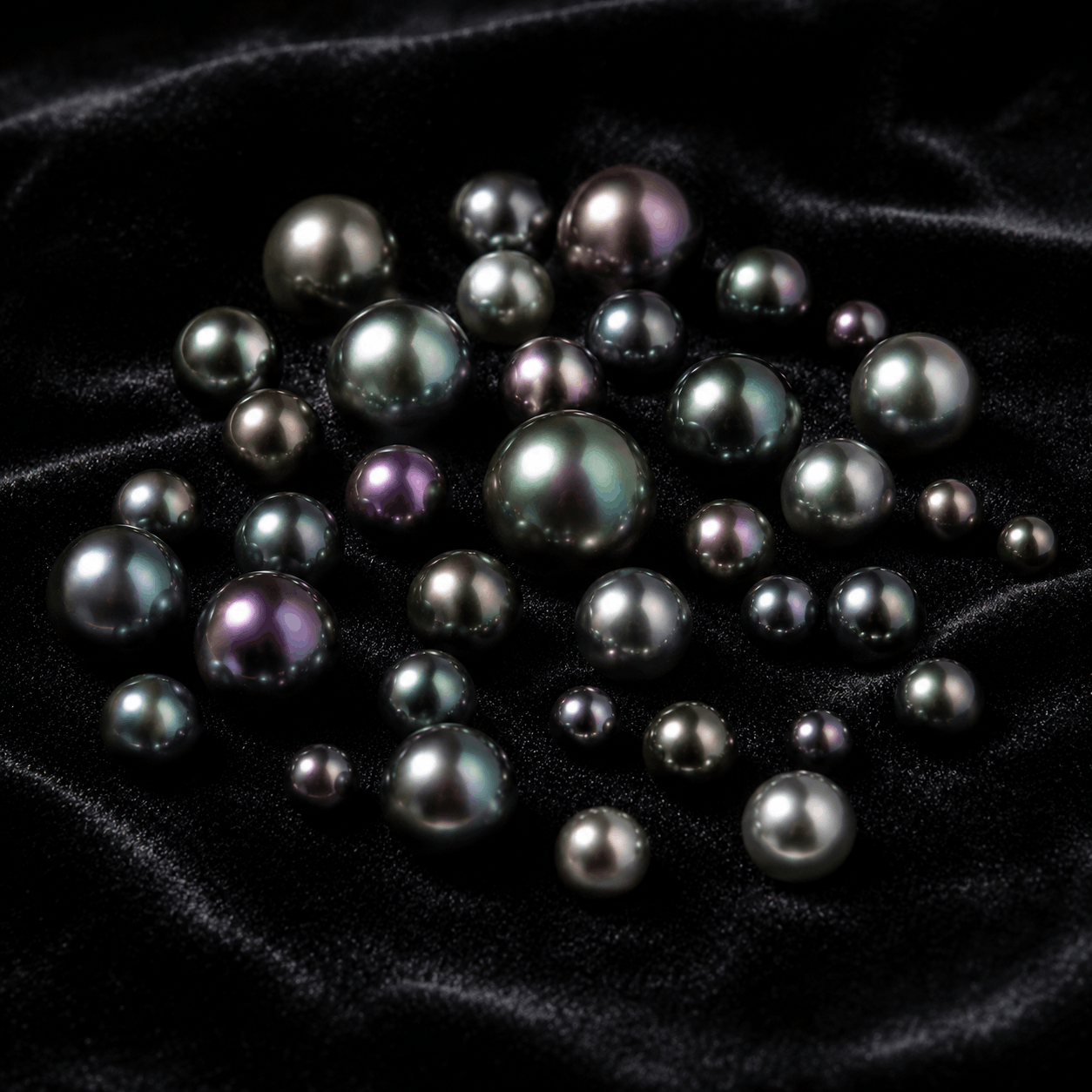
A jeweler friend called me once to look at a parcel of loose Tahitian pearls she’d been offered. Forty-three pearls. Various sizes. A mix of shapes and overtones. She wanted a second opinion before committing. We spent about an hour going through them one by one under a daylight lamp. Six were exceptional. Twelve were very good. The rest were average at best. And three were genuinely poor — thin nacre, dull surface, no overtone worth mentioning. All forty-three were being sold as “premium grade.” That experience taught me more about how to buy loose Tahitian pearls than anything I’d read. So here’s what actually matters — and what to watch out for.
What Are Loose Tahitian Pearls
Loose Tahitian pearls are unstrung individual pearls harvested from the black-lipped Pinctada margaritifera oyster in French Polynesia. Unlike finished jewelry pieces, loose pearls haven’t been drilled, strung or set yet. So they give buyers the most flexibility — you can select individual pearls for custom jewelry projects, commission a matched set, or simply collect quality pearls over time and have them set later.
That flexibility is exactly why loose Tahitian pearls appeal to a specific type of buyer. Custom jewelry designers. Collectors. Brides who want a say in every element of their pearl piece. Or simply buyers who understand pearl quality well enough to want to select each pearl individually rather than accepting a pre-matched strand. The trade-off is that buying loose requires more knowledge upfront. But that’s exactly what this guide is for.
Loose Tahitian Pearl Colors and Overtones
Color is the first thing that makes loose Tahitian pearls extraordinary — and the most misunderstood. The body color of a Tahitian pearl ranges from light grey through silver, dark grey and near-black. But body color is only half the story. The overtone — that iridescent secondary color sitting on top of the base — is what makes each pearl genuinely unique.

Peacock overtone is the most prized. A green-gold iridescence over a dark body that shifts with the light in a way that’s genuinely difficult to describe until you’ve seen it. Aubergine runs deep purple over dark grey and reads as extraordinarily luxurious. Cherry adds a reddish-rose warmth that’s rarer and particularly beautiful against warm skin tones. Silver-green is the most classic dark tone — less dramatic than peacock but very wearable and widely available. And pistachio — a yellow-green overtone — is one of the more unusual and sought-after colors in the loose Tahitian pearl market right now. When buying loose, always evaluate overtone under natural daylight. Indoor lighting flattens color and makes accurate assessment almost impossible.
Loose Tahitian Pearl Size Guide
Tahitian pearls run larger than most other cultured pearl types. The typical size range for loose Tahitian pearls runs from 8mm to 18mm — with 9mm to 12mm covering the most widely available and most practical range for jewelry use. Anything below 8mm is considered small for a Tahitian pearl. Anything above 14mm is genuinely rare and priced accordingly.

Size affects price significantly but not linearly. The jump from 10mm to 12mm in a high-grade round Tahitian pearl can more than double the price. So when building a matched set of loose pearls for a necklace — where you need pearls that graduate slightly in size from clasp to center — size selection becomes a precise and time-consuming process. That’s part of why matched loose Tahitian pearl sets cost more than they might appear to. The matching is where the real work happens.
Shape — What to Look for in Loose Tahitian Pearls
Tahitian pearls come in a wide range of shapes and shape affects both value and application significantly. So understanding the shape categories before buying loose is genuinely important.

Round is the rarest and most valuable shape. A perfectly spherical Tahitian pearl rolls in a straight line on a flat surface. In loose form, true rounds represent only a small percentage of any harvest. Near-round is one step down — slightly off-perfect but not noticeably so in finished jewelry. Drop and teardrop shapes are elongated with a tapered end — beautiful in pendant and earring applications where the shape hangs naturally. Oval sits between round and drop in character. Button is flattened on one or both sides — excellent for earring settings where a flat base holds the pearl securely. And baroque is the freeform category — irregular shapes with complex surface character that interact with light in ways more uniform shapes don’t. Semi-baroque sits between near-round and fully irregular. Often the most interesting shapes visually. And frequently the best value in loose Tahitian pearls per quality unit.
Luster — The Most Important Quality Factor
If you only learn one thing about evaluating loose Tahitian pearls, make it luster. Luster is the depth and intensity of light reflection from the nacre surface. And in Tahitian pearls specifically — which are saltwater pearls with naturally thick nacre — luster should be extraordinary. Not just shiny. Dimensional. Deep. Almost like the light is coming from inside the pearl rather than bouncing off it.

High-grade loose Tahitian pearl luster will show your reflection on the surface — distorted but recognizable. That’s the benchmark. Medium luster shows strong reflection but without that mirror-like depth. Low luster looks dull or chalky — the color might be present but the life isn’t. And low luster is the single biggest indicator of thin nacre, which means the pearl won’t age well. So when buying loose Tahitian pearls, always check luster first under natural daylight. If it doesn’t stop you, move on.
Surface Quality and Nacre Thickness
Surface quality runs from AAA — near-flawless with minimal imperfections only visible under magnification — down through AA and A grades with increasingly visible marks, bumps and irregularities. For loose Tahitian pearls destined for jewelry use, AA is generally the practical minimum. AAA commands a significant premium but the visual difference in a finished piece, especially in earrings or pendants where the pearl is seen from limited angles, may not always justify the cost difference. Worth evaluating case by case.

Nacre thickness is the structural quality factor that determines longevity. French Polynesian regulations require a minimum nacre thickness of 0.8mm for exported Tahitian pearls. But genuine top-grade loose pearls typically run 1.5mm to 3mm or more. Thicker nacre means deeper luster, more complex overtone and a pearl that genuinely improves with wear rather than dulling over time. Always ask for nacre thickness documentation when buying loose. Any reputable seller provides it without hesitation.
How to Buy Loose Tahitian Pearls Wisely
Buying loose Tahitian pearls well comes down to four things. First — buy under natural daylight or a daylight-balanced lamp. Store and indoor lighting flatters everything and hides flaws that would be immediately obvious outdoors. Second — evaluate each pearl individually. Not as a lot. Not by average. Each pearl on its own merits before deciding if the group works together.

Third — know what you’re building before you buy. A matched necklace requires close size and color consistency across every pearl. A baroque bracelet gives you much more latitude. A single pendant needs one exceptional pearl rather than a well-matched group. Your end use determines which quality factors matter most. And fourth — buy from sellers who provide full documentation. Pearl type, origin, size, shape grade, surface grade, luster grade and nacre thickness should all be clearly stated. Anything vague at this level is a red flag. Period.
Loose Tahitian Pearls vs Pre-Set Jewelry
So should you buy loose or just buy a finished piece? Honestly it depends entirely on what you want. Pre-set Tahitian pearl jewelry is the right choice for most buyers — the matching is done, the setting is chosen and you know exactly what you’re getting. Finished pieces are also easier to evaluate because you can see the full effect rather than imagining it.

Loose Tahitian pearls make sense when you want complete creative control. When you have a specific custom piece in mind that doesn’t exist in a finished form. When you’re a collector building a quality parcel over time. Or when you have access to a trusted jeweler who can do the setting work and you want input on every pearl selected. At PearlsOnly, both options are available — browse the full loose pearl collection or explore finished Tahitian jewelry to find the approach that fits how you actually want to buy.
