
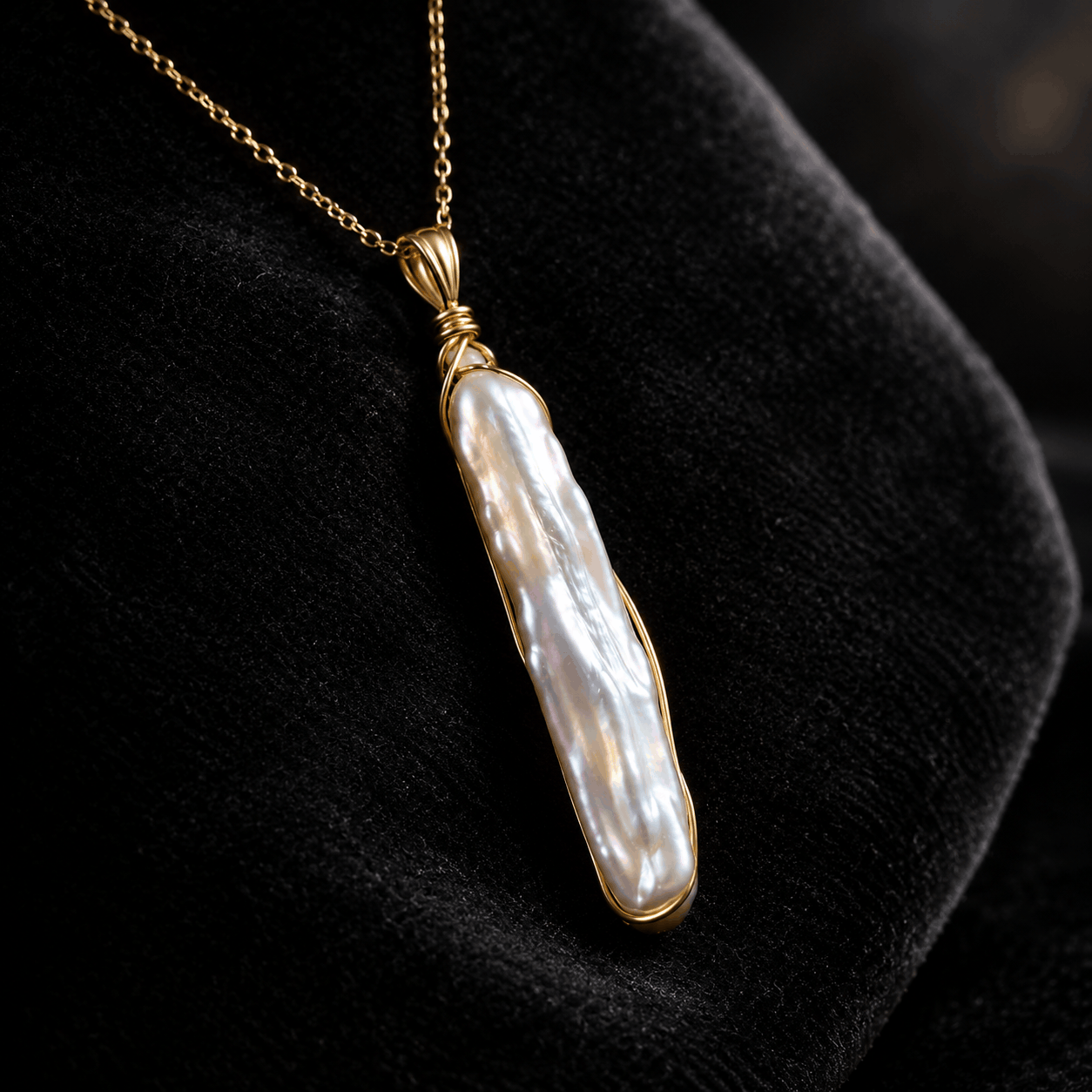
A jeweler friend pulled out a biwa pearl pendant at a trade show once and put it on the table without saying anything. Long. Flat. Irregular. A pearlescent stick of nacre with a depth and surface complexity that round pearls simply don’t have. Three people asked what it was before she said a word. That’s the thing about a biwa pearl pendant — it looks unlike anything else in fine jewelry. So here’s everything worth knowing about what it actually is, where it comes from and how to wear one well.
What Is a Biwa Pearl Pendant
A biwa pearl is a type of freshwater pearl named after Lake Biwa in Japan — historically the world’s most important source of freshwater pearl cultivation. Biwa pearls were produced in the Hyriopsis schlegelii mussel without a bead nucleus, which is why they formed in distinctive elongated, flat or irregularly shaped forms rather than the round shapes most pearl buyers expect. The nacre grew directly around a tissue irritant, producing pearls that are nearly solid nacre from center to surface.
Today genuine Lake Biwa pearl production is extremely limited — pollution and environmental changes have dramatically reduced harvests from the original source. So most pearls sold as “biwa style” or “biwa pearls” today are actually Chinese freshwater pearls grown in a similar nucleation method that produces comparable elongated shapes. Both are genuine freshwater cultured pearls with real nacre. But a true Lake Biwa pearl — documented with Japanese origin certification — is increasingly rare and collectible. So always ask about origin when buying a biwa pearl pendant described as authentic Japanese biwa.
What Makes a Biwa Pearl Pendant So Distinctive
The biwa pearl’s defining characteristic is its shape. Unlike round or near-round pearls, biwa pearls form in elongated flat or stick-like shapes — sometimes resembling a small smooth petal, sometimes a thin irregular tablet, sometimes a baroque organic form with complex surface variations. And that shape is exactly what makes a biwa pearl pendant so visually arresting.

In a pendant setting, the elongated biwa pearl hangs naturally from the bail and moves differently from a round pearl — creating subtle motion with every step that catches light in a continuously changing way. The flat surfaces also show luster differently. Rather than the spherical reflection of a round pearl, a biwa pearl pendant shows luster across a broader flat plane — softer in some lights, more luminous in others. And because each biwa pearl forms differently, no two biwa pearl pendants look exactly the same. That individuality is genuinely rare in fine jewelry at this price point.
Biwa Pearl Pendant Shapes and Sizes
Biwa pearl shapes fall into several recognizable categories — and shape affects both the character of the pendant and how it hangs in a setting. So understanding the main shape types before buying helps significantly.
Stick or rice biwa pearls are elongated and roughly cylindrical — the most classic biwa form. In a pendant setting they hang vertically and create a long elegant drop that suits V-necks and open collars beautifully. Flat or coin biwa pearls are disc-shaped — wider than they are thick. They hang flat against the skin in a pendant setting and catch light across a broader surface area than a round pearl would. Petal biwa pearls are flat, irregularly shaped and sometimes slightly curved — organic and distinctly hand-crafted in character. And keshi biwa pearls are small, highly lustrous and entirely byproduct nacre — no nucleus at all. Among the most lustrous freshwater pearl forms available and genuinely striking in pendant settings.

In terms of size, biwa pearls in pendant use typically run from 8mm to 25mm in length — significantly larger apparent size than round pearls at the same price point because of their elongated form. A 15mm stick biwa pearl pendant reads as a substantial, distinctive piece without the cost of a 15mm round South Sea pearl of equivalent visual presence.
Biwa Pearl Pendant Luster — What to Expect
Luster is the most important quality factor in any pearl — and biwa pearls have a specific luster character worth understanding before buying. Because biwa pearls are nearly solid nacre with no bead nucleus, the luster tends to be soft and deep rather than sharp and mirror-like. It’s an inner glow rather than a surface reflection. Sometimes described as silky. Dimensional. Like light emerging from within the pearl rather than bouncing off the surface.
Top-grade biwa pearl pendants show this quality clearly under natural light — the flat surfaces glow with a warmth that draws the eye in a way that faceted gemstones don’t replicate. Lower-grade biwa pearls can look chalky or dull — the luster is absent and the shape alone doesn’t compensate. So always evaluate luster in natural daylight before buying any biwa pearl pendant. If the surface looks flat or lifeless under natural light, the nacre quality simply isn’t there. Move on.
Biwa Pearl Pendant Settings — Getting the Metal Right
Setting a biwa pearl requires a different approach from setting a round pearl — the irregular shape means standard bezel and prong settings don’t always work. So the setting style matters more with biwa pearls than with most other pearl types.

Wire wrap settings are the most common and most natural format for biwa pearl pendants. The metal wire wraps organically around the pearl rather than confining it in a rigid mount — creating a handcrafted, artisan quality that suits the organic character of the biwa pearl perfectly. Yellow gold wire wrap brings warmth to cream and white biwa pearls. Rose gold adds a romantic softness. And sterling silver keeps things modern and cool against the soft nacre glow. Bail-drilled settings — where a hole is drilled through the top of the pearl and a bail inserted directly — are clean and minimal. Good for stick and rice-shaped biwa pearls where the elongated form hangs naturally without needing a setting to frame it. And for flat coin or petal biwa pearls, a simple bezel or rim setting that echoes the disc shape can create an elegant framed effect that reads as very contemporary.
How to Style a Biwa Pearl Pendant
A biwa pearl pendant is genuinely one of the most versatile fine jewelry pieces for contemporary styling. And the styling approach is simpler than most buyers expect. Let the pearl’s shape and luster lead — keep everything else clean and minimal around it.

For everyday wear — a stick biwa pearl pendant on a fine 18-inch gold chain tucked inside a white shirt collar is an understated, deeply personal look that rewards close attention. For evenings — the same pendant worn outside the collar against a simple dark dress is quietly extraordinary. And for layering — a biwa pearl pendant at 18 inches alongside a shorter delicate chain at 16 inches creates a contemporary two-layer look where the organic biwa shape creates visual interest that a round solitaire pendant doesn’t. The irregular form of the biwa pearl is exactly what makes layering combinations work without looking too uniform or conventional.
Biwa Pearl Pendant vs Baroque Pearl Pendant
These two categories overlap and are sometimes confused — so it’s worth understanding the distinction. Baroque pearls are the broad category for any irregularly shaped pearl — round pearls that didn’t form symmetrically, freeform organic shapes, bumpy or uneven surfaces. Biwa pearls are a specific type of baroque — defined by their elongated flat or stick shape and their Japanese freshwater origin or the Chinese freshwater production that replicates that character.

So all biwa pearl pendants are baroque — but not all baroque pearl pendants are biwa. The biwa form is more specific, more distinctive and generally more recognizable as a jewelry shape. If you want something freeform and organic, baroque is the broader category. If you want something specifically elongated, flat and with that distinctive silky biwa luster, look for biwa specifically. Both are genuinely beautiful — but they suit different aesthetics and different styling contexts.
How to Buy a Biwa Pearl Pendant
A few things are worth checking before committing to any biwa pearl pendant purchase. Luster first — the surface should show a warm silky glow under natural light. Not flat. Not chalky. Deep and luminous. If it doesn’t stop you when you hold it under daylight, the nacre quality isn’t there. Surface quality next — biwa pearls naturally show more organic surface variation than round pearls, so some irregularity is expected and appropriate. But significant blemishes, cracks or rough patches indicate low-grade base pearl quality that no setting will improve.

Ask about origin. True Lake Biwa pearls from Japan command a premium and should come with documentation. Chinese freshwater pearls in biwa style are genuine quality alternatives at more accessible prices — but shouldn’t be sold as Japanese biwa without documentation to support that claim. And check the setting quality — the bail should be securely attached, the wire wrap or bezel should hold the pearl firmly and the chain should be a quality match for the pendant. Browse the full freshwater pearl collection at PearlsOnly to find biwa and baroque pendant options across a range of shapes, sizes and settings — all with full grading documentation and a 90-day return guarantee.
