
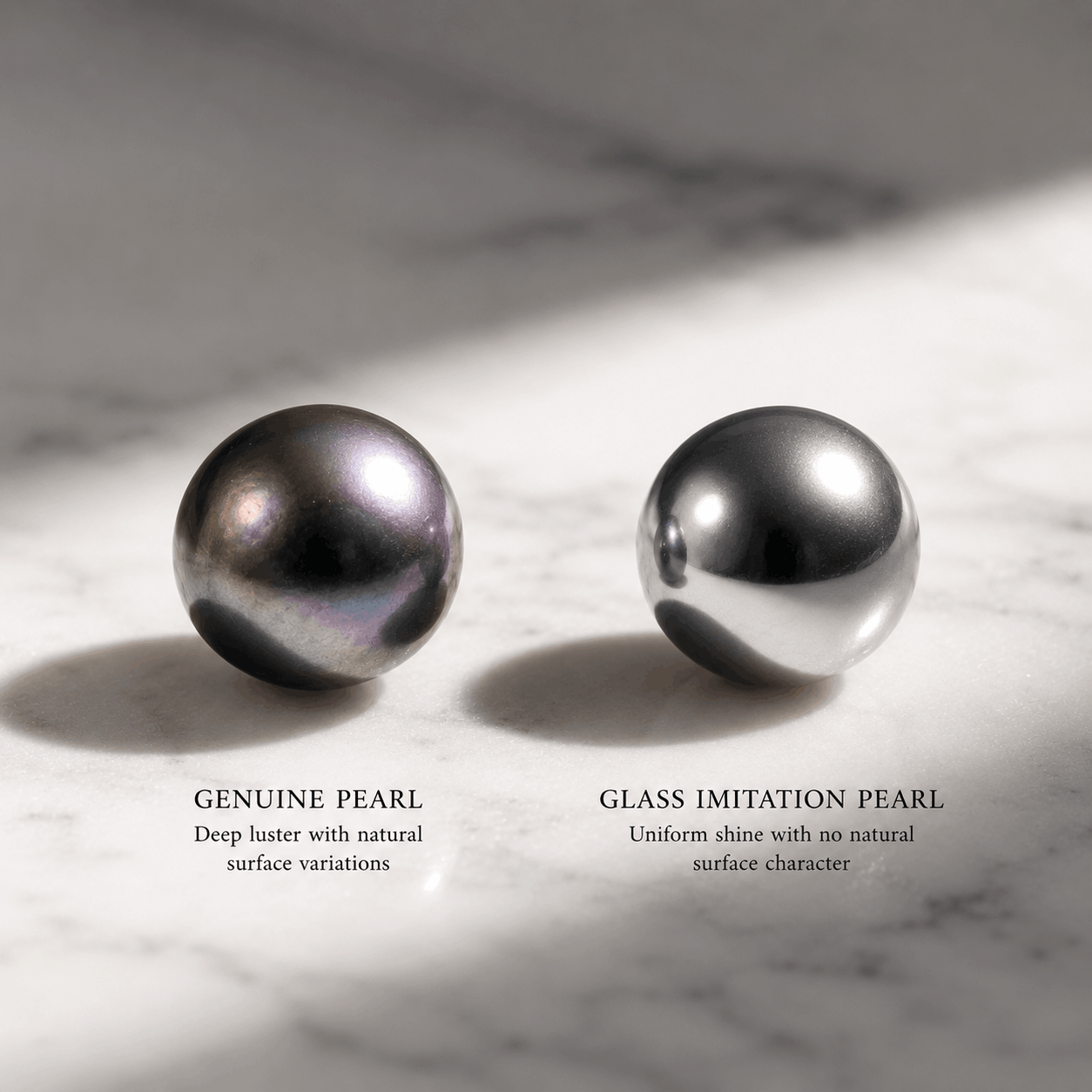
Inherited a pearl necklace and have no idea if it’s real? Considering buying a strand and want to verify before committing? Or just curious after seeing something at a market that seemed too good to be true? Knowing how to see if a pearl is real is genuinely one of the most useful things you can learn — and it takes about sixty seconds once you know what to look for. So here are six tests that actually work. No equipment. No lab. Just the pearl and a few things you already have.
Why Knowing How to See If a Pearl Is Real Matters
The fake pearl market is bigger than most buyers realize. Glass pearls, plastic pearls, shell-coated imitations and high-end Majorica fakes all circulate at various price points — some obviously cheap, others surprisingly convincing at first glance. And the stakes are real. A strand sold as “genuine cultured pearls” at a market, an estate sale or even some retail environments may be nothing of the sort. So knowing how to tell if a pearl is real before buying or accepting a piece as genuine protects your money and your trust.
The good news is that genuine pearls — natural or cultured — have specific physical properties that fakes simply can’t fully replicate. Real nacre has a layered crystalline structure that behaves differently from glass, plastic or shell coatings under examination. And most of the tests to see if a pearl is real exploit exactly that difference. No expertise required. Just observation and a willingness to rub a pearl against your tooth.
Test 1 — The Tooth Test: Fastest Way to See If a Pearl Is Real
This is the single most reliable quick test available. Gently rub the pearl against the edge of your front teeth. Real pearls feel gritty — almost like fine sand — because of the layered nacre structure on the surface. Fake pearls feel smooth. Completely glassy. No texture at all.

The difference is genuinely unmistakable once you’ve felt both. So if possible, try the tooth test on a pearl you already know is genuine first — just so you have a clear reference point for what gritty actually means before testing anything uncertain. Takes five seconds. Works almost every time. The only fake that partially resists this test is high-end Majorica pearls — but even those feel less gritty than genuine nacre under careful comparison.
Test 2 — The Visual Test: How to Tell If Pearls Are Real by Looking
Before any physical test, look carefully at the pearl. Real pearls — whether natural or cultured — grow inside a living organism over months or years. That biological process leaves traces. Subtle surface variations. Slight shape differences from one pearl to the next on a strand. A surface that isn’t completely uniform or perfectly flawless under close inspection. Fake pearls are manufactured to a consistent standard — so they look suspiciously identical. Too round. Too smooth & too perfect.

So hold the strand up and look along it under natural light. If every single pearl looks like an exact copy of the one beside it — perfectly uniform in shape, surface and color — that’s a red flag rather than a sign of quality. Real strands, even high-grade ones, show slight natural variation pearl to pearl. That small inconsistency is what genuine looks like. Perfection, oddly enough, is the warning sign.
Test 3 — The Luster Test: See If a Pearl Is Real by Its Glow
Luster is the depth and quality of light reflection from the pearl surface. And it’s one of the most reliable visual indicators of how to know if a pearl is real. Hold the pearl under natural daylight — not indoor lighting which flatters everything. Real pearls show a deep layered glow that shifts subtly as you tilt the pearl. The light enters the nacre layers and reflects back with dimension and warmth. That quality is called orient. Fake pearls throw back a flat, harsh, one-dimensional shine — no depth, no movement in the light.

High-grade real pearls will almost show your reflection on the surface — mirror-like or close to it. If the surface looks like it has a coating painted on rather than something growing from within, it probably does. So the luster test is particularly useful for catching higher-end fakes that pass the visual test but can’t replicate the dimensional depth of genuine nacre.
Test 4 — The Weight Test
Real pearls feel heavier than you’d expect for their size. Nacre is a dense organic material — so even a small genuine pearl has noticeable heft when you roll it in your palm. Plastic fakes feel light and slightly hollow by comparison even at the same diameter. Glass fakes can feel heavier and are more convincing on weight — but they still fail other tests. So weight alone isn’t conclusive. But as part of a broader assessment it’s a useful data point that takes two seconds to check.
Test 5 — The Temperature Test
Press the pearl against the inside of your wrist or your lips. Real pearls feel cool at first — the same way stone or ceramic does — and then warm up gradually as you hold them. Plastic stays room temperature or has that faintly synthetic feel from the first contact. Glass can also feel cool initially which is why this test works best in combination with others. But together with the tooth test and luster check, temperature adds one more confirming data point to a picture that’s becoming increasingly clear.
Test 6 — The Drill Hole Test: How to Tell If a Pearl Is Real on a Strand
This test is particularly useful for strung necklaces and bracelets. Zoom in on the drill holes with your phone camera. Genuine pearls show clean sharp edges at the hole — and you can often see the nacre layering right at the rim. That layered structure is genuinely difficult to fake convincingly. Fake pearls show rough or chipped edges around the hole. And sometimes the coating is already starting to peel or flake right at that point — because drilling is exactly where a painted surface breaks down first.

So if you spot peeling anywhere near the drill hole, the question of real vs fake pearls answers itself immediately. No further testing needed. And even without obvious peeling — the quality of the drill hole edge alone tells you a great deal about the nacre structure underneath. Clean and sharp means real layered material. Rough and chipped means a coating over something else.
Real vs Fake Pearls — Quick Comparison
Here’s a summary of what each test reveals across genuine pearls and common imitations.

| Test | Real Pearls | Fake Pearls |
|---|---|---|
| Tooth test | Gritty, sandy texture | Smooth and glassy |
| Visual | Slight natural variation pearl to pearl | Perfectly uniform and identical |
| Luster | Deep layered glow with dimension | Flat harsh shine with no depth |
| Weight | Dense and noticeably heavy | Light or hollow feeling |
| Temperature | Cool at first, warms gradually | Room temperature or synthetic feel |
| Drill holes | Clean sharp edges, nacre visible | Rough or chipped, coating may peel |
When Home Tests Aren’t Enough
Home tests handle the vast majority of everyday situations confidently. But for anything genuinely valuable — an estate piece, a significant purchase or anything where uncertainty remains after all six tests — professional verification is worth pursuing. A jeweller or gemologist can use X-ray imaging to show the concentric nacre growth rings inside a real pearl that no imitation can replicate. Magnification under proper lighting reveals nacre structure clearly. And some genuine pearls fluoresce under UV light in ways fakes don’t replicate.

At PearlsOnly every pearl necklace and pearl set comes with full grading documentation and a certificate of authenticity — so you never need to wonder how to see if a pearl is real after buying from us. Browse the full collection and buy with a paper trail, not just a promise.
FAQ: How to See If a Pearl Is Real
Is the tooth test always accurate? For most everyday situations yes — gritty means real nacre, smooth means fake coating. The only partial exception is very high-end Majorica fakes which feel slightly less smooth than plastic but still don’t match genuine nacre texture. Combine the tooth test with the luster and visual checks for the most confident result.
Can cultured pearls fail these tests? No. Cultured pearls are genuine pearls grown inside a living oyster or mussel with real nacre. So they pass every test listed above exactly the way natural pearls do. Cultured simply refers to how the farming process started — not to the material itself.
Do real pearls ever look perfect? Rarely. Even top-grade AAA pearls show minor natural variation under close inspection. A strand that looks absolutely perfect and uniform across every single pearl is more likely an imitation than a genuinely high-quality piece. Perfection is the red flag.
What’s the single most reliable test? The tooth test — fast, free and works almost every time. But combining it with the luster check and the drill hole check gives you the most confident result without any equipment at all.
